

What is a WDI inspection? A guide for home buyers
Published Updated
 By John Stopka, Co-Founder & CEO · Reviewed by John Stopka
A WDI inspection is a check for visible evidence of wood-destroying insects — termites most of all — made when a home is being bought or refinanced. The inspector records what can be seen on the day of the inspection, and the results are reported on Form NPMA-33. It tells you what the evidence showed that day. It is not a statement that a home has no termites.
What is a WDI inspection?
It is an inspection of a home for visible evidence of wood-destroying insects, done as part of a purchase or refinance.
WDI stands for wood-destroying insect. University of Kentucky entomologists explain why it comes up when it does: termites are "particularly relevant when buying or selling a home since a termite inspection/infestation report is normally a condition of sale" [1].
Liberty puts it the same way:
A WDI (wood-destroying insect) inspection is done when a home is being bought or refinanced. We check for visible evidence of termites and of damage from carpenter bees and carpenter ants.
Which insects count as wood-destroying insects?
More than termites — which is why it is a wood-destroying insect inspection, not a termite inspection.
- Carpenter ants. They "tunnel through moist wood, but can also inhabit dry wood", and "given enough time their damage can be significant to the integrity of the structure" [2].
- Carpenter bees. "Though seldom as destructive as termites, carpenter bees can cause cosmetic and structural damage" [3]. They nest in eaves, rafters, fascia boards, siding and decks [3].
- Powderpost beetles. Another wood-destroying group, "second only to termites in their ability to damage dry, seasoned wood" [4].
Liberty's WDI inspection covers termites, carpenter bees and carpenter ants.
Who asks for a WDI inspection, and when?
Almost always someone working to a closing date.
It is usually required as part of the sale rather than something the buyer chooses to arrange.
The realtor, the buyer or the seller can request it. When you book, tell us how we'll get in and who's paying.
What is the inspector actually looking for?
Evidence you can see, and the conditions that invite insects in.
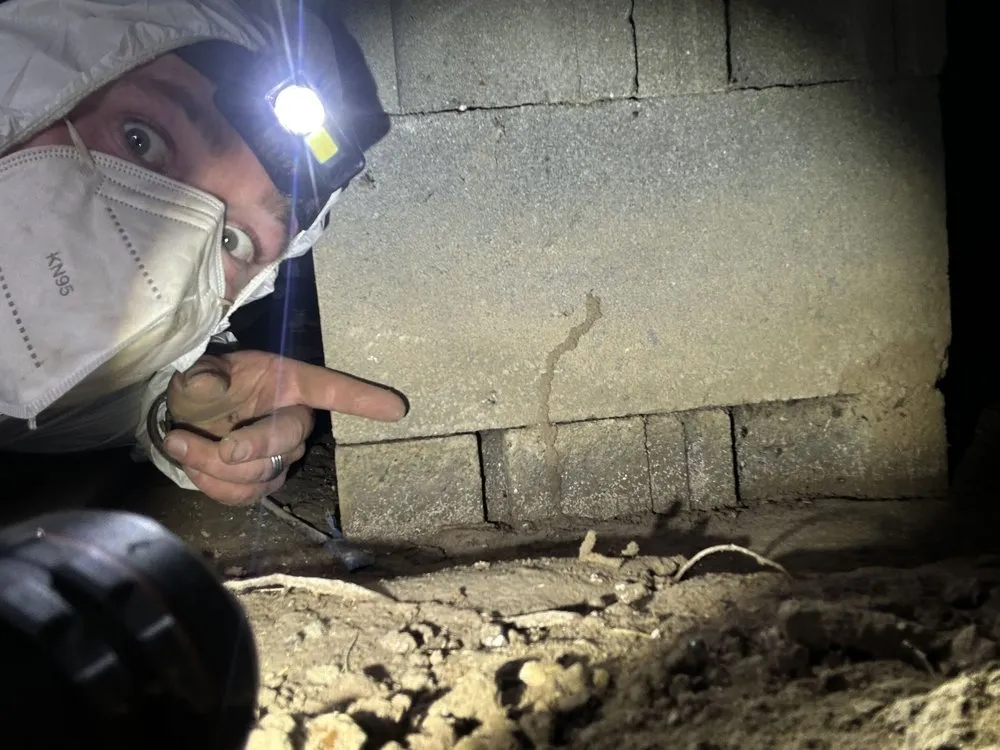
The clearest termite sign is a mud tube, built for shelter as termites travel between their underground colony and the structure. Mud tubes are "typically about the diameter of a pencil, but sometimes can be thicker", and run over foundation walls, piers, sill plates and floor joists [1].
Damaged wood is the next one: it is "hollowed out along the grain, with bits of dried mud or soil lining the feeding galleries" [1]. Termites also bore tiny holes through drywall with soil around the margin [1].
Winged insects matter too: "Discovering winged termites indoors almost always indicates an infestation warranting treatment" [1], which is why shed wings on a windowsill get written down. To identify what you found, see flying ants vs termites and termite swarm season.
Then the conditions. "Termite problems often occur when wood components of the building are in direct contact with soil", and termites "are more likely to infest if the soil next to the foundation is consistently moist" [5].
What does the report say, and what does it not?
It says what was visible on the day of the inspection. That is the whole scope.
Your WDI inspection results are reported on Form NPMA-33, the standard Wood Destroying Insect Inspection Report from the National Pest Management Association. It's approved for FHA and VA loans. Lenders set their own requirements, so ask your lender or real estate agent what your closing needs.
What it is not is a promise about the parts of the house nobody can see. "Termites are cryptic creatures and infestations can go undetected for years, hidden behind walls, floor coverings, insulation, and other obstructions", and confirming them "often requires the keen eye of a professional -- however, even the most experienced inspector can overlook signs that are hidden" [1].
So a report with no evidence noted means none was visible that day, in the areas the inspector could reach. It is not a certificate that the home has never had termites, and not a prediction about next year.
What does it mean if the report notes evidence?
It means the inspector saw something, and the next question is whether it is active.
Evidence is not the same as an active infestation. A mud tube can be broken open and checked for small, creamy-white worker termites, but "If a tube happens to be vacant, it does not necessarily mean that the infestation is inactive; termites often abandon sections of tube while foraging elsewhere in the structure" [1].
A note on the report is information, not a verdict on the house. It leads to a second conversation: what was found, where, and whether it is live. There is normally time for it — "Termites damage wood slowly" [1].
Treatment is not a do-it-yourself job: ridding a home of termites "requires special skills", and retail products "will seldom eradicate an existing termite problem" [1]. Termite control is the next step, not a trip to the hardware store.
How does Liberty do a WDI inspection?
A WDI inspection is its own service, with a posted price, separate from the free termite inspection anyone can book.
You book it online and our office reaches out to confirm your time and access details. Have ready: the property address, whether you're the buyer, the realtor or someone else, how we'll get in, your closing deadline and who's paying.
Your WDI report is emailed after payment. A Liberty WDI report is good for 90 days, which matters when a closing date moves.
When to call a professional
Call when a purchase or refinance needs a WDI report, or when something along the foundation looks like a mud tube and you want to know what it is.
Call as well if a report came back with evidence noted and you are not sure what that means. Telling old evidence from an active infestation takes a trained eye, and it decides whether termite control is needed.
Common questions
What does WDI stand for?
Wood-destroying insect. The inspection checks for visible evidence of insects that damage wood: termites above all, plus carpenter ants, carpenter bees and wood-boring beetles [1][2][3][4].
Does a clean WDI report mean the home has no termites?
No. It means no visible evidence was found that day, in the areas the inspector could reach. Termite infestations can go undetected for years behind walls, floor coverings and insulation, and even an experienced inspector can overlook hidden signs [1].
Does a WDI inspection cover more than termites?
Yes. Carpenter ants and carpenter bees damage wood too [2][3]. Liberty's WDI inspection covers termites, carpenter bees and carpenter ants.
How long is a WDI report good for?
A Liberty WDI report is good for 90 days. If your closing moves well past that, ask whether a new one is needed.
What happens if the report notes evidence of termites?
It becomes a question of whether the infestation is active. An empty mud tube does not by itself mean it is inactive, because termites abandon sections of tube while foraging elsewhere [1]. Termites damage wood slowly, so there is usually time to find out.
Who can request a WDI inspection?
The realtor, the buyer or the seller can request it. When you book, tell us how we'll get in and who's paying.
Sources
- University of Kentucky Entomology. Michael F. Potter. "Termite Control: Answers for Homeowners" (ENTFACT-604). https://entomology.mgcafe.uky.edu/ef604 (opens in a new tab)
- University of Kentucky Entomology. Allison Lopina and Zach DeVries. "Carpenter Ants" (ENTFACT-603). https://entomology.mgcafe.uky.edu/ef603 (opens in a new tab)
- University of Kentucky Entomology. Michael F. Potter. "Carpenter Bees" (ENTFACT-611). https://entomology.mgcafe.uky.edu/ef611 (opens in a new tab)
- University of Kentucky Entomology. Michael F. Potter. "Powderpost Beetles" (ENTFACT-616). https://entomology.mgcafe.uky.edu/ef616 (opens in a new tab)
- University of Kentucky Entomology. Michael F. Potter. "Protecting your Home Against Termites" (ENTFACT-605). https://entomology.mgcafe.uky.edu/ef605 (opens in a new tab)