

Ants in the kitchen: why they come in and what to do
Published Updated
 By John Stopka, Co-Founder & CEO · Reviewed by John Stopka
Ants come into kitchens looking for food and water, and they often show up after heavy rain [1][2]. Most kitchen ants nest outside, in walls or under floors, and trail in to crumbs, spills and sweets [1][2]. Clean up food, fix moisture problems and seal entry points, and call a professional if ants keep coming back [1][2].
Why are there ants in my kitchen?
They're looking for food and water [1].
Sugary foods draw ants to kitchens, and moisture draws them to bathrooms [2]. Ants often move indoors after heavy rains [2].
Worker ants travel in trails. They like to follow lines and edges, like baseboards and the seam where siding meets the foundation [1].
What kind of ants are in my kitchen?
In Kentucky, the ants that most often come into homes include pavement ants, odorous house ants, carpenter ants, acrobat ants and Pharaoh ants [1]. Illinois Extension names odorous house ants, carpenter ants and pavement ants among the ants that come indoors in Illinois [2].
| Ant | What to look for |
|---|---|
| Odorous house ant | Small, about 1/8 inch, and blackish. Smells like rotten coconut when crushed [1][2]. |
| Pavement ant | Fine grooves on the head, and two bumps (nodes) at the waist [1]. |
| Carpenter ant | Larger, black or red and black, with one node at the waist and an evenly rounded middle section. Tunnels in wood, especially moist wood, but doesn't eat it [3]. |
Where are the ants coming from?
Follow the trail. It leads back to where the ants get in, and toward the nest [1].
Inside, ants can nest behind walls, cabinets and appliances, behind door and window frames, and under floors and concrete slabs [1]. Outside, they nest under rocks, boards and firewood [2].
To find a hidden trail, the University of Kentucky suggests putting a little honey or jelly on an index card. Ants that find it will show you their path [1].
How do you keep ants out of the kitchen?
Take away food and water, and close the gaps they use [1][2].
- Wipe up crumbs and spills, clean out cabinets and keep food in sealed containers [1][2].
- Fix leaks and other moisture problems [1].
- Improve airflow in damp rooms like bathrooms [2].
- Seal door thresholds, windows and the openings where pipes and wires enter the house [1].
- Caulk cracks and openings [2].
- Trim plants that touch the house [1].
What do winged ants in the kitchen mean?
Winged ants swarming inside mean there's an active nest nearby. They're unlikely to start a new colony indoors [1].
Two things are worth checking:
- Is it a termite? Ants have bent antennae, a pinched waist and front wings longer than the back ones. Termite swarmers have straight antennae, a thick waist and wings of equal length [4].
- Is it a carpenter ant? Finding a lot of winged carpenter ants indoors in spring points to a nest inside the home. Small piles of sawdust-like debris are another sign [3].
How does Liberty treat ants in the kitchen?
Here's how we handle household ants on a Liberty pest control plan. Signs of household ants:
- Lines of ants along counters, baseboards or windowsills
- Ants gathering around crumbs, spills, pet food or sinks
- Small piles of soil next to sidewalks, slabs or the foundation
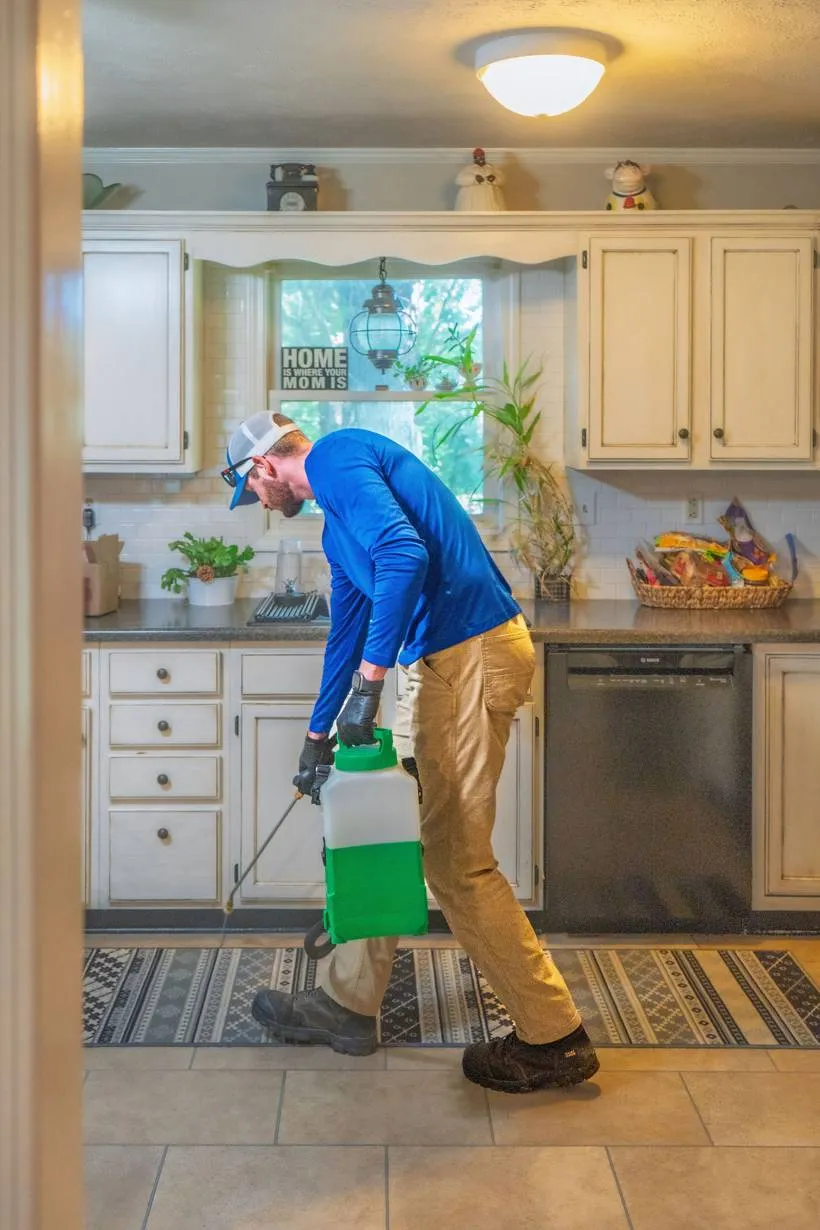
On your first visit, your Service Specialist does a thorough inspection inside and outside to see how bad the ant problem is, where ants are getting in and what draws them, like crumbs, spills, pet food and leaks.
- Perimeter barrier: Your Service Specialist applies a perimeter barrier around your home's foundation for crawling insects, to help keep ant trails outside.
- Inside treatment: Your first visit always includes treatment inside where ants trail, like kitchens and bathrooms, and on later visits they treat inside only if it's needed and ask you first.
- Bait and granules: They add granules in the landscape areas and place ant bait where needed, which worker ants carry back to the nest.
If covered pests show up between visits, just text us.
Carpenter ant treatment starts with a free inspection. A local Service Advisor does a thorough inspection to see how bad the problem is, where the ants are getting in and nesting, and what draws them, like damp or softened wood, leaks and branches touching the house.
In kitchens across Western Kentucky and Southern Illinois, the ant our Service Specialists find most often is the odorous house ant.
When to call a professional
Call if ants keep coming back after you've cleaned up and sealed gaps, if you see winged ants inside, or if you spot sawdust-like piles that could mean carpenter ants.
Household ants are covered by every Liberty pest control plan. See our ant page to learn how we treat them, or our pest control page for plans. Carpenter ants aren't part of our plans and start with a free inspection.
Common questions
Why do ants come in after it rains?
Heavy rain often sends ants indoors, where they look for food. Sugary foods draw them to kitchens and moisture draws them to bathrooms [2].
What are the tiny black ants in my kitchen?
One common kitchen ant is the odorous house ant. It's small, about 1/8 inch long, blackish, and smells like rotten coconut when crushed [1][2].
How do ants get into the house?
Ants get in through gaps around door thresholds and windows and the openings where pipes and wires enter. Sealing those gaps helps keep them out [1].
How do I find where the ants are coming from?
Follow the ant trail back to where it starts. A little honey or jelly on an index card can help you see a trail that's hard to spot [1].
Are carpenter ants the same as kitchen ants?
No. Carpenter ants are larger, black or red and black, and tunnel in wood, especially moist wood. Finding sawdust-like piles or many winged carpenter ants indoors in spring points to a nest in the home [3].
Sources
- University of Kentucky Entomology. "Ant Control for Householders." https://entomology.mgcafe.uky.edu/ef619 (opens in a new tab)
- University of Illinois Extension, Flowers, Fruits, and Frass blog. "Ants in the Kitchen." May 2, 2019. https://extension.illinois.edu/blogs/flowers-fruits-and-frass/2019-05-02-ants-kitchen (opens in a new tab)
- University of Kentucky Entomology. "ENTFACT-603: Carpenter Ants." https://entomology.mgcafe.uky.edu/ef603 (opens in a new tab)
- University of Kentucky Entomology. "ENTFACT-604: Termite Control: Answers for Homeowners." https://entomology.mgcafe.uky.edu/ef604 (opens in a new tab)